

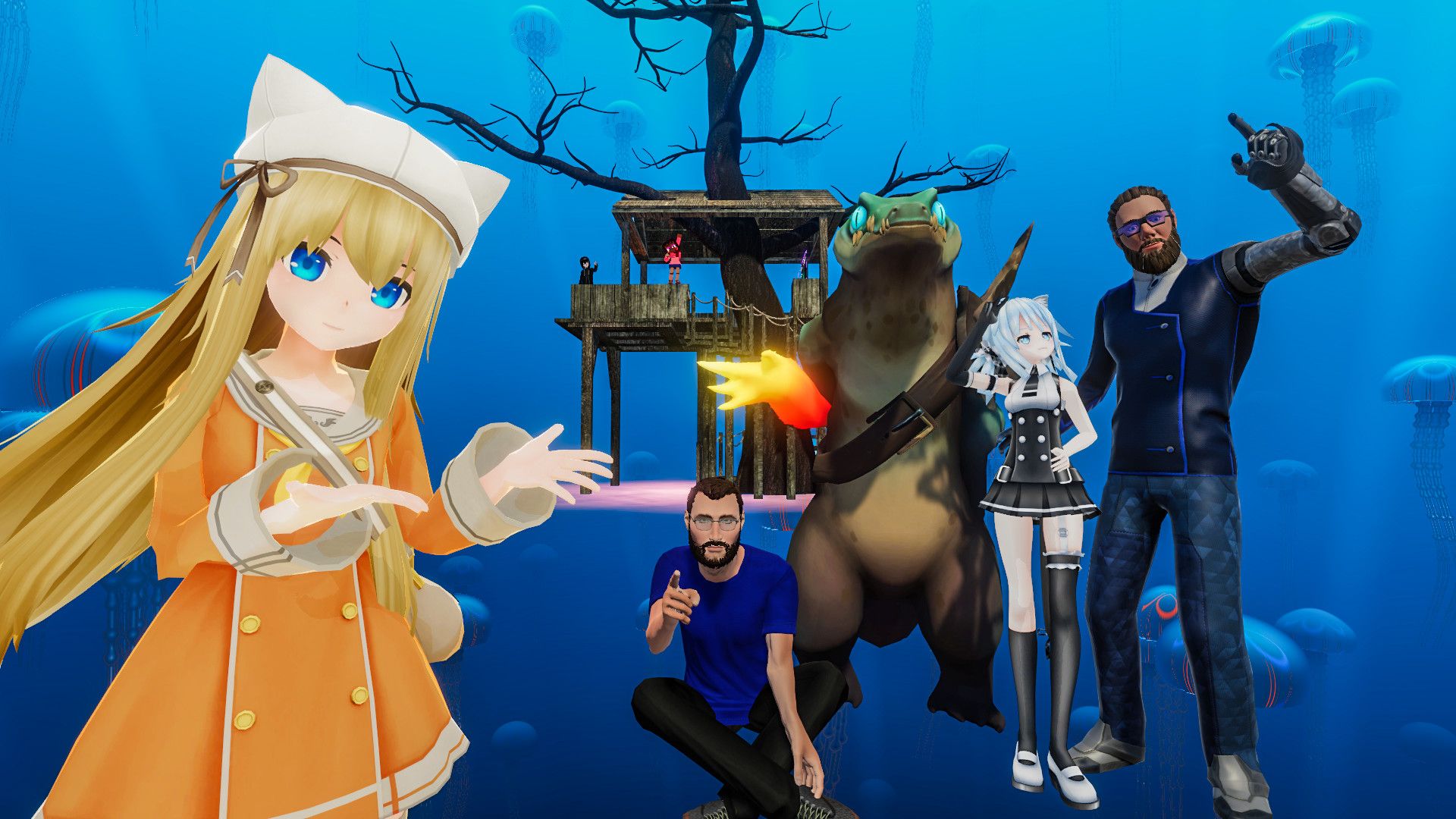
“VRChat” is a virtual-reality space where people can chat and meet other people online who have all sorts of different interests and personalities. To a young teen who struggles socially, the diversity and welcoming community of “VRChat” seems like a great way to build a persona and be whoever they have always wanted to be behind an avatar. “VRChat” gives teenagers something that the real world does not: freedom without judgment.
Socializing on the platform seems easier; there are no social norms that teens are desperately trying to follow to be accepted. At school, many teens feel they are not the most popular kid, and they wish they were different—cooler, funnier, charming. But once they put on the headset and step into the “VRChat” world, they become the coolest, funniest and even the sexiest person ever.
However, these teens fail to see the addictive impact of “VRChat” in their real world. This happens when their family starts to miss them since they stopped coming downstairs as much; when they start to fall asleep with the headset on after hours of playing, “VRChat” starts to consume their dreams, or when they begin to interact with online predators.
The experiences I listed are not hypothetical. They happened to me and others I know. I will unpack the grasp that “VRChat” had on me as a young teen, how it impacted my life, how “VRChat” can affect other teens in my position and how it affects the people around them.
I was born with Attention Deficit Disorder, commonly known as ADD, and I struggled with learning in school. I did not know I had a learning disorder during elementary school, but I knew something was different since my friends were not getting pulled out of class into a special group like I was. While school often didn’t make sense to me, I started searching for ways that did. I sought places where my mind could move freely.
But through my years at elementary school, I discovered that I had a passion for video games. It was an entirely new way of thinking, and one that I actually enjoyed. I played Super Mario games with my little brother, and sometimes we played with our other friends.
My mom transferred me to a private Catholic middle school so I could have more opportunities. I was scared, since most of my friends went to middle schools they were zoned to. In addition, this school was a K-8 private school, so starting in 6th grade while most other students attended since kindergarten scared me.
This school didn’t end up accommodating my ADD well, and I almost failed 6th grade. I struggled socially because these kids already had established friend groups since kindergarten.
I hated going to school every day. I was miserable, and the only thing I could look forward to were playing video games when I got home. My dad started buying games like “The Legend of Zelda,” and I started to love puzzle games that got me to think differently. I became invested in puzzle-driven games, while my brother started leaning more into online competitive games like “Fortnite.”
Video games were my source of happiness in the 6th grade. I had no friends and felt estranged. But that all changed when my brother received a VR headset for Christmas.
When I strapped on the headset, it felt like my world had changed. I was “living” in what I loved most: video games. But this time, I wasn’t playing alone. There was a whole community of people that I had no idea even existed. People who were just like me, who have no friends and love to game. Nobody knew how “lame” I was at school; they just saw my funny online persona. I made lots of “online friends” that I shared this cool “VRChat” gaming experience with. From then on, I spent every waking moment of my free time in “VRChat.” I downloaded Discord so I could talk to my friends during the day.
What I learned through my time in “VRChat” is that not everyone is looking to make friends. There were predators who would talk about explicit topics that I did not know how to process at age 13. These conversations were sexual, harmful and filled with pressure. However, the surreality of VRChat blinded me. Conversations like that became the norm.
started playing “VRChat” whenever I could. I would steal my brother’s VR headset so I could get more play time. I waited mindlessly at school until the day was over so I could talk to my online friends. I stopped talking to the few people who interacted with me at school, since I didn’t feel cool when I was with them. I even started dating on “VRChat.” My grades began to slip, I started becoming more isolated at school, and I started to hate my reality.
I fell into a depression, and “VRChat” was my drug.
My mom noticed a change when I started locking myself in my room for hours on end and not doing anything productive. She then decided to go through my phone, and she saw my worrying Discord messages.
My mom had a conversation with me explaining that my online life is not healthy and that I am losing myself. She took away the headset and put me into therapy. I fell into a deeper depressive state as I felt like I lost all the people I knew, and that my perfect reality was gone. My mom, on the other hand, felt like she was losing her daughter and was hoping that my mental state would improve.
Thankfully, therapy helped me a lot. I hated the idea of talking about it, but my therapist stayed with me while I cried about my online friends and didn’t judge me. It was because of my therapist that I learned how to socialize during my freshman year of high school. I joined a swim team and built an amazing community with them. I made my reality the reality that I always wanted, and I began to love school. I became the funny, social person who I dreamed of.
What happened in my life had real consequences. I was exposed to explicit topics that I should not have learned about at a young age. I thought that nothing was wrong, but I needed outside help.
In high school, I learned that the “VRChat” addiction I had faced was more common than I originally thought. I saw people telling their story about “VRChat” addiction on YouTube, and I made a friend who went through a similar experience. I wasn’t alone.
I recently asked my friend Caitlin how “VRChat” affected her. She stated, “It made me dread going into the outside world. I didn’t enjoy life as much as I should have outside of a headset.” This goes to show that “VRChat” gives a false sense of a “better reality,” and being exposed to that at a young age can feel life-changing.
According to the PEW Research Center, “For today’s teens, friendships can start digitally: 57% of teens have met a new friend online. Social media and online gameplay are the most common digital venues for meeting friends.” This demonstrates how easy it is to meet people online, especially on platforms like “VRChat” with a diversity of interests.
Video game addiction has grasped kids so deeply that there is now an official disorder name for it. Gaming disorder is a mental health condition recognized by the World Health Organization in which a person loses control over gaming behavior and continues to play despite serious negative effects on their life.
I did not realize I was falling into this disorder until my mom took away the VR headset and put me into therapy. It was hard for me at first—I felt like my real friends got taken away from me and that I had nobody. However, the “exposure therapy” of completely having the VR headset taken away and being forced to do other activities helped me. I realized how much time I had during the day and how many more real, better friends I could make. Limiting my access to VR didn’t help me, since I would just anxiously wait until I got to be with it again. The only way I could truly heal was to have it taken away, and I got to learn to love my reality again.
In the end, I learned that, to play a game as immersive as “VRChat,” I needed to love my actual reality for it to be healthy. Even though what happened to me was unfortunate, I learned from it. I started to build the girl I wanted to be. I learned to socialize, tell jokes, and grew to be an outgoing person.
Online friendships can be meaningful to lonely people, but young teens need guidance to not get addicted and fall into a gaming disorder, as I did. My story isn’t to shame “VRChat,” but to teach others that balance matters. I learned to build a life outside of the headset, and I hope others can as well. Real friendships that love you for who you are are better than any avatar.








Great personal account. Balance really is everything.