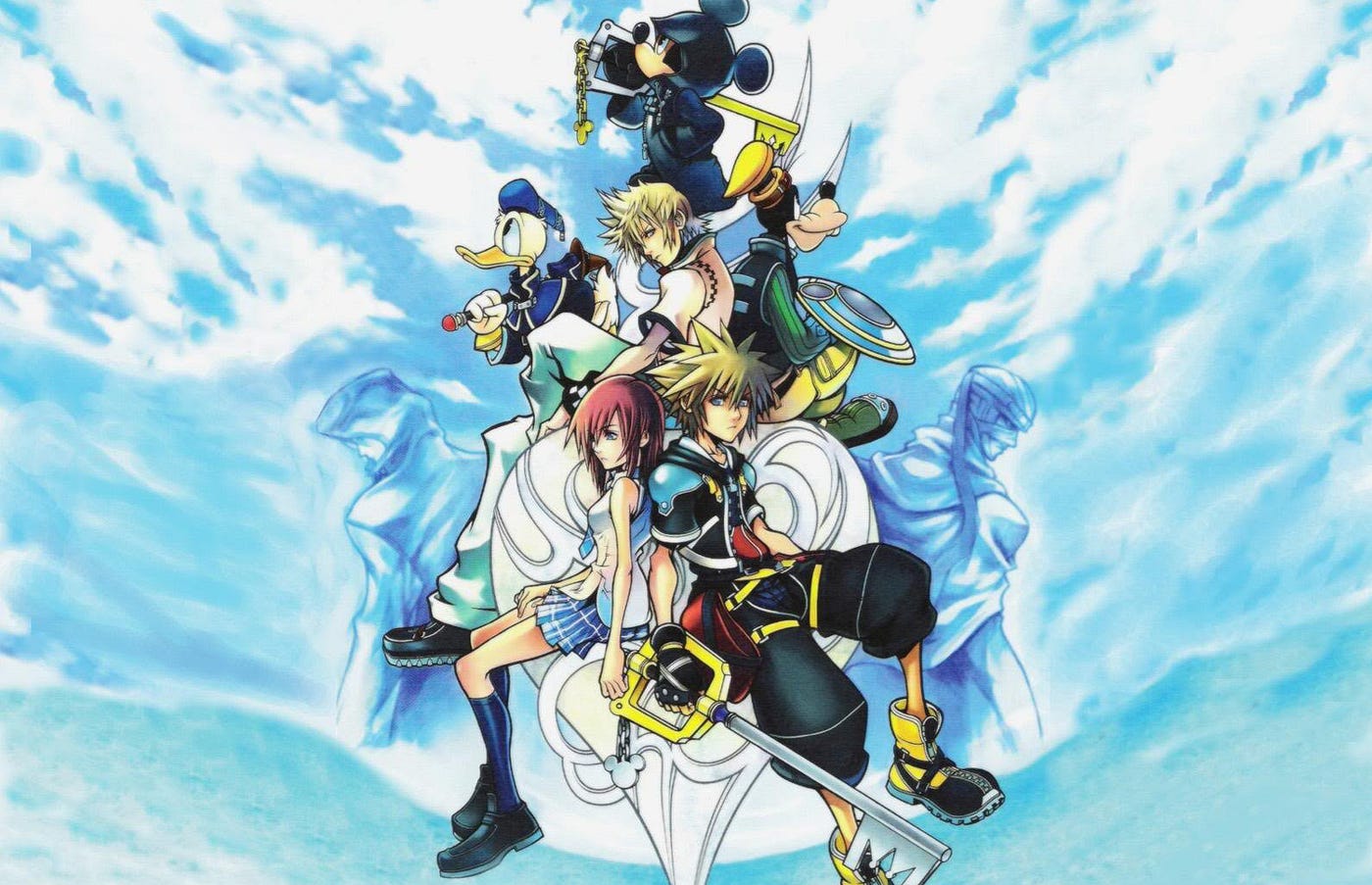
The OU Game Developer’s Association holds general body meetings focused on an in-depth discussion of a selected game. Each meeting typically follows a structured format—engineering, game design, visual arts, sound, and narrative—to provide a comprehensive analysis across all committees. This article summarizes our October presentation on Kingdom Hearts II: Final Mix, a 2007 Japanese-exclusive re-release of Kingdom Hearts II featuring additional content, later remastered internationally as Kingdom Hearts 2.5 for the PS3 in 2014.

Game Design
KH2.5 refines the Kingdom Hearts formula into a real-time action RPG that rewards skill, awareness, and creativity rather than brute force. The game fuses Final Fantasy’s heroic fantasy mechanics with Disney’s emotional storytelling, creating combat that feels cinematic without losing interactivity. Reaction Commands, Drive Forms, and Limits make battles dynamic spectacles, while fluid mobility—air combos, dashes, and form-based movement—gives players a sense of agency and style. Mastery here is intentional: flashy, expressive, and satisfying rather than grind-heavy.
Difficulty modes shape player mindset. Standard and Proud offer accessible challenges, but Critical Mode flips expectations: players face double damage, slower growth, and early access to powerful abilities, forcing thoughtful resource management and tactical play. Even low-level enemies can be lethal, emphasizing observation and adaptability over button-mashing. The design encourages players to internalize patterns and mechanics, teaching through consequence rather than explicit instruction.
Combat itself is layered and rhythmic. Physical combos combine ground and aerial strings with launchers and finishers, teaching timing and combo flow. Magic relies on a burst–recharge tempo that balances offense and defense. Reaction Commands reward precision and enemy reading, and Limits serve as cinematic punctuation, reinforcing when and how to strike. Together, these systems make skill feel meaningful, blending rhythm, timing, and strategy into every encounter.
Teamwork and transformation further diversify combat. Sora fights alongside allies and summons, while Drive Forms temporarily alter combat style and unlock new movement abilities, adding both utility and flair. Worlds function as design lessons: each introduces a mechanic or scenario, culminating in bosses that test mastery. In the Land of Dragons, the Morale Gauge and timed objectives instill urgency and strategic thinking, showing how level design reinforces core combat principles.
Visual Arts
Color and shape are essential tools for communicating meaning in character design. Color is more than decoration—it signals action, influences mood, and can even affect physiological responses such as heart rate, metabolism, and eyestrain. Each color carries associations: blue often suggests wisdom, calm, or hope, while red conveys passion, energy, or power. Designers must carefully select colors to convey a character’s personality, role, or emotional tone, understanding that every hue contributes to the overall visual language of the design. Positive and negative associations exist for all colors, making choices critical to creating intended impressions.
Shape psychology complements color by influencing perception and emotional response. Rounded shapes feel approachable and friendly, while sharp angles suggest aggression, danger, or strength. Shapes create visual cues that communicate character traits quickly and intuitively. Together with color, shape forms the backbone of character silhouette, which is crucial for recognition and readability. A strong silhouette ensures that the character is instantly identifiable, even in motion or from a distance.

Sora’s outfit demonstrates how color and shape work in tandem. His dominant black color represents maturity and power, aligning with his heroic nature, while touches of red, blue, and yellow highlight courage, energy, and action. The oversized gloves, shoes, and layered garments create a distinctive silhouette with playful, rounded shapes, signaling approachability and youthfulness. At the same time, angular elements in his belts and straps add subtle hints of complexity and readiness for battle. Every choice—from hue to garment proportion—functions as visual language, communicating his character without words.
In sum, successful character design relies on the careful integration of color, shape, and silhouette. Designers must consider how each element conveys meaning, evokes emotion, and reinforces personality. By thinking of every visual choice as part of a language, characters like Sora become memorable, expressive, and instantly readable to audiences.

Sound

In Kingdom Hearts, music is more than background—it is immersion, shaping the emotional and narrative experience. Yoko Shimomura, a legendary JRPG composer, crafts symphonic, cinematic scores that blend Disney wonder with Final Fantasy drama. Her use of leitmotifs—repeating musical themes tied to characters or ideas—creates cohesion across the series, allowing players to connect emotionally with the story.
Each Disney world has two primary tracks: an overworld theme for exploration and a battle theme for combat. Music adapts dynamically, shifting tempo and instrumentation to match gameplay intensity while preserving recognizable motifs. The 2.5 Remix updates these arrangements, enhancing depth and clarity without losing their emotional core.
“Sanctuary,” composed by Shimomura and originally a piano-led lullaby, serves as a unifying theme across the series. KH2’s arrangement feels warmer and nostalgic, evoking maturity and reflection. It embodies the bittersweet beauty of memory, the connection between hearts, and the balance of hope and melancholy—the musical expression of “light within darkness.”
Utada Hikaru’s songs, including Passion and Sanctuary, reinforce these themes in KH2’s opening, exploring identity, memory, rebirth, loss, and connection. Through this interplay of orchestration and vocal performance, Kingdom Hearts’ soundtrack frames the emotional journey, reminding players that before any battle or adventure, the series begins—and ends—with a quiet, reflective heart.

Narrative
Kingdom Hearts treats death not just as an end, but as transformation. Roxas’ prologue embodies this quietly devastating apocalypse. As he fades, so does the world around him, a “quiet apocalypse” where the cost of connection is revealed: to awaken Sora, Roxas must cease to exist. The player doesn’t merely witness this loss—they live it, moving through the stages of grief alongside him.
Denial colors the beginning of Roxas’ journey. He clings to ordinary life: summer’s last warmth, school routines, laughter with friends. Glitches in reality are dismissed as “weird dreams,” and the ticking clock signals time he refuses to acknowledge. This fragile normalcy, familiar and comforting, masks the approaching truth.
Anger rises as the illusion shatters. Roxas lashes out against Organization XIII, resenting manipulation and fate. Battles become symbolic tantrums, his rage giving him identity in a life that was never truly his. The world grows more mysterious and threatening, reflecting the intensity of his inner turmoil, the questions multiplying even as answers vanish.
Bargaining follows, desperate and almost tender. Roxas clings to friends, side quests, and errands, grasping for anything that might delay the inevitable. Even the world seems to freeze, mirroring his attempts to negotiate with fate itself. Namine’s plea—“He needs you, Roxas”—becomes both a reminder and a comfort, a fleeting hope that connection can endure.


Depression settles in as Twilight Town empties and memory unravels. The palette softens, silence dominates, and cutscenes merge with gameplay. Here, loss is not hopelessness but awareness: a quiet stillness that prepares him for acceptance.
Acceptance transforms Roxas’ journey into transcendence. He walks willingly into the light, completing Sora’s heart. The tone shifts from despair to bittersweet serenity. Death here is not erasure but continuity: Roxas’ sacrifice reframes Sora’s life, giving weight, meaning, and emotional resonance. Through his journey, Kingdom Hearts teaches that grief is a process, one that reshapes identity, fosters empathy, and reveals that the end of one story is the beginning of another. Roxas’ fading is sorrowful, yet it is also luminous—a quiet reminder that connection endures beyond loss.
About This Article
This article is in collaboration with The University of Oklahoma’s Esports & Co-Curricular Innovation program, its Crimson Collective Journal media outlet, and The Game Developer’s Association (GDA).
GDA is dedicated to educating Sooners about various aspects of game development engineering, game design, narrative, sound, and visual arts. We break down games in detailed analysis presentations and guide students in creating their own during Game Jam competitions.
If you’re curious about game development—or just want to connect with a vibrant community of creators—we’d love for you to join us. All the ways to find OU GDA are linked below.
Thank you for reading—we hope to see you soon!
Discord: https://discord.gg/99WV8gYk
Website: https://sites.create.ou.edu/gamedev/
Newsletter: https://bejewelled-halva-5a2d45.netlify.app/
Instagram: https://www.instagram.com/ougamedev/
Gmail: [email protected]